



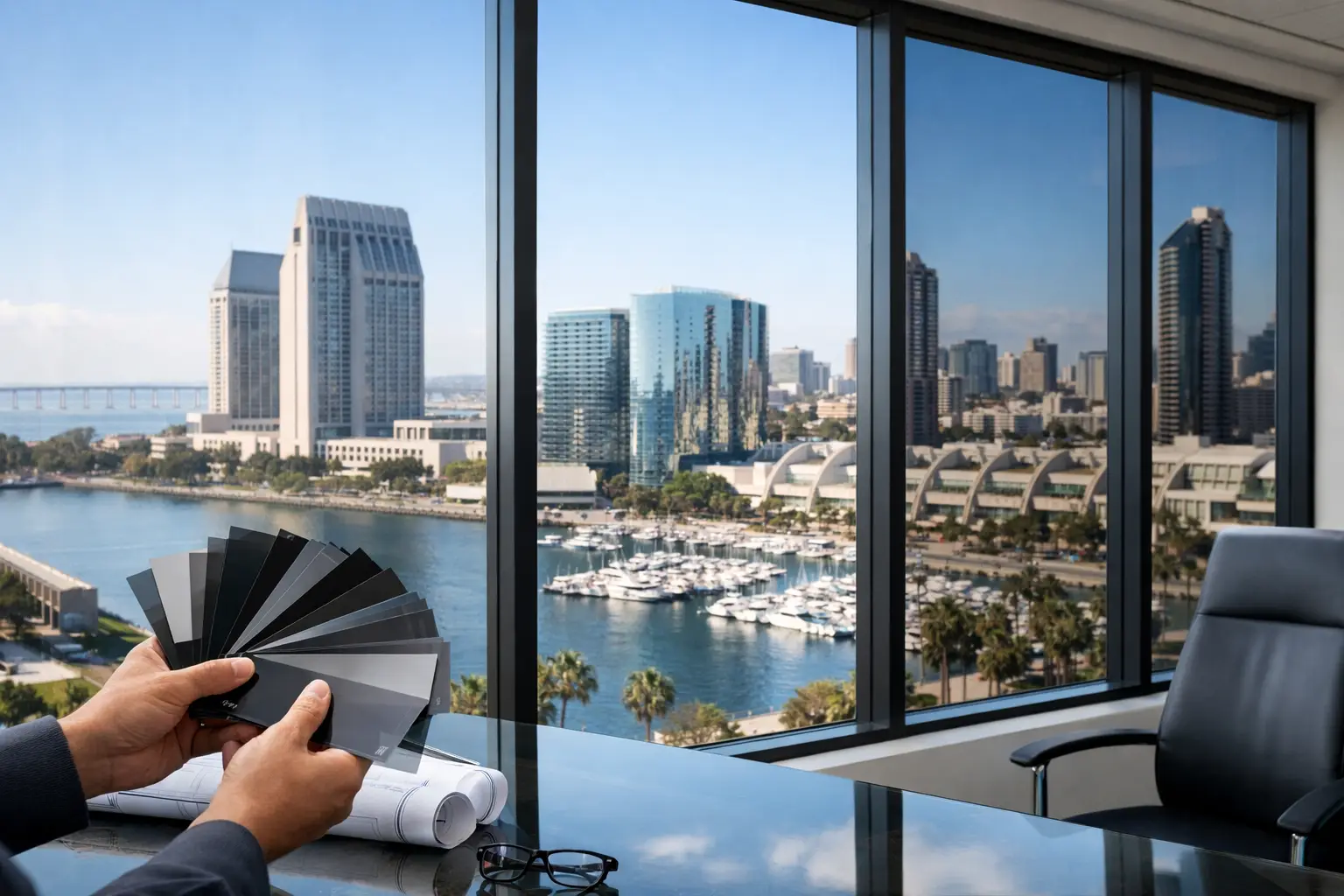
A west-facing office can feel 10 to 15 degrees warmer than the rest of the building by midafternoon. Employees close blinds, customers avoid sunny seating areas, and the HVAC system works harder than it should. This commercial tinting buyers guide helps San Diego property owners and managers choose window film based on the problems they need to solve, not just the darkness of the glass.
Commercial window film is a practical upgrade for offices, storefronts, restaurants, medical buildings, schools, warehouses, and multi-tenant properties. The right product can reduce solar heat, cut glare, protect furnishings, improve privacy, or add a layer of glass safety. The wrong product can leave the building too dark, create compatibility issues with insulated glass, or fail to address the real source of discomfort.
Start With the Problem, Not the Film Shade
Window film is not a one-product purchase. A film that works well for a glass storefront may not be the right choice for a conference room, a server room, or a tenant space with sensitive displays. Before comparing brands, identify what happens at the windows during the hottest, brightest part of the day.
If the primary issue is excessive heat, prioritize solar-control film with strong infrared and total solar energy rejection. If employees struggle to read monitors or customers complain about harsh reflections, glare reduction may be the main requirement. When a ground-floor office needs more discretion, decorative, frosted, or reflective privacy film may make more sense than a dark solar film.
Many properties need more than one outcome. A south- or west-facing elevation may need heat and glare control, while interior glass partitions need privacy film. A qualified installer can recommend different films for different areas rather than treating every window the same.
Understand the Performance Numbers
Film specifications can look technical, but a few numbers make product comparisons much easier. Do not choose based on visible darkness alone. A lighter ceramic or spectrally selective film may reject significant heat while maintaining a bright, professional interior.
Visible Light Transmission
Visible light transmission, often shown as VLT, is the percentage of visible light that passes through the glass and film. A higher VLT keeps the room brighter. A lower VLT creates a darker appearance and can reduce glare more aggressively.
For commercial properties, the best choice depends on the use of the space. Retail locations often want ample daylight and clear views into the business. Conference rooms, reception areas, and offices with screens may benefit from moderately lower VLT. Darker is not automatically better, especially if tenants rely on natural light or local appearance requirements limit reflective glazing.
Heat Rejection and Infrared Control
Total solar energy rejected measures how much solar heat the window system keeps out. Higher numbers generally mean less heat entering the space, which can reduce hot spots and HVAC demand.
Infrared rejection is also worth reviewing, particularly in San Diego’s intense sun. However, it should not be evaluated by itself. Some products advertise high infrared performance over a narrow range of wavelengths. Compare the full product specification sheet, including total solar energy rejected, visible light transmission, and glare reduction, to understand the expected real-world result.
UV Protection and Fade Reduction
Quality commercial window films block up to 99% of ultraviolet rays. This helps protect flooring, furniture, artwork, merchandise, and interior finishes from fading and deterioration. UV protection is valuable, but it is not the only factor in fading. Visible light and solar heat also contribute, so a solar-control film can provide broader protection for sun-exposed interiors.
Glare Reduction
Glare affects more than comfort. It can make computer work difficult, reduce visibility at a reception desk, and create an unpleasant experience for diners or shoppers. Films with stronger glare reduction can help, but they usually reduce incoming light as well. The right balance is one that improves screen visibility without making the workspace feel closed in.
Choose the Right Type of Commercial Window Film
Most commercial projects fall into a few main film categories. Each serves a different purpose, and the right selection depends on glass type, building use, and the desired appearance.
Solar-control film is the most common option for commercial buildings. It reduces heat, glare, UV exposure, and cooling load while improving occupant comfort near sun-facing windows. Ceramic and spectrally selective films are often good choices when a property wants heat performance with a relatively clear appearance.
Reflective film can provide stronger daytime privacy and heat reduction. It is useful for storefronts, offices, and street-facing glass where an exterior mirrored look fits the property. The trade-off is that privacy reverses at night when interior lights are on. Anyone outside may be able to see in more easily than people inside can see out.
Decorative film is well suited for conference rooms, medical offices, glass partitions, entry doors, and tenant improvements. Frosted, patterned, and custom-cut options create privacy while allowing light to pass through. It can also add a clean, finished look without replacing existing glass.
Safety and security film is designed to help hold broken glass together after impact. It can be a practical option for vulnerable storefront windows, schools, public-facing counters, and properties concerned about break-ins or accidental glass breakage. It does not make glass unbreakable, and its performance depends on the film thickness, attachment method, and the framing system. For higher-risk locations, ask whether a mechanical attachment or wet-glaze system is recommended.
Anti-graffiti film is a sacrificial protective layer applied to smooth surfaces such as exterior glass, mirrors, metal, and certain panels. When vandalism occurs, the damaged layer can be removed and replaced instead of replacing the underlying surface. For properties with repeat graffiti exposure, that can reduce disruption and repair costs.
Check Glass Compatibility Before Approving a Film
This is where professional assessment matters most. Modern commercial buildings may use tempered glass, annealed glass, laminated glass, insulated glass units, low-emissivity coatings, or specialty glazing. Applying the wrong film to the wrong glass can increase thermal stress and raise the risk of glass breakage or seal issues.
A reputable commercial tinting contractor should inspect the glass, identify existing coatings where possible, measure pane sizes, and review the building conditions before recommending a product. This is especially important for older glass, large panes, dark frames, partial shade patterns, and insulated units.
Do not assume a film is appropriate because it looks similar to one used on another building. The glass construction and sun exposure can be completely different. Request a recommendation supported by manufacturer-approved compatibility guidance and a clear warranty.
Consider Appearance From Both Sides of the Glass
Commercial tinting changes the appearance of a property, which can be a benefit or a concern depending on the building. Film samples should be viewed on the actual windows at different times of day. A sample that looks subtle indoors may appear more reflective from the street.
For multi-tenant buildings, shopping centers, and properties governed by an HOA or architectural guidelines, approval may be needed before installation. Check lease obligations and local building requirements as well. A property manager may want a uniform exterior appearance, while individual tenants may have different needs inside their suites.
Nighttime visibility deserves special attention. Reflective film provides the strongest daytime privacy when exterior light is brighter than interior light. At night, the effect changes. If around-the-clock privacy is required, decorative film, blinds, shades, or a combination of solutions may be necessary.
Compare Installation Quality, Not Just the Estimate
The lowest quote is not always the lowest long-term cost. Commercial window film must be cut accurately, applied to properly prepared glass, and finished cleanly around frames, mullions, seals, and hardware. Poor installation can lead to contamination, peeling edges, visible gaps, or premature failure.
Ask what film brand is being installed, whether the product is intended for commercial flat glass, and what warranty applies to both the material and workmanship. Recognized manufacturers such as 3M and SunTek offer commercial film options with documented performance data and manufacturer-backed warranties when installed correctly.
For occupied buildings, the installation plan also matters. Confirm whether work can be scheduled around business hours, how furniture and work areas will be protected, and whether exterior access equipment is needed. Mobile service is convenient, but commercial work still requires clear communication, safe jobsite practices, and respect for tenants and customers.
Build a Scope That Matches Your Budget
A full-building installation may deliver the most consistent appearance and energy benefit, but it is not the only option. Many businesses start with the elevations that receive the most direct afternoon sun, the offices with recurring comfort complaints, or the storefront glass that creates the most glare.
A phased project can be a smart approach when budgets are limited. Start with the windows that affect employee comfort, customer experience, or cooling costs most, then expand after seeing the results. It is usually more effective than selecting a lower-performing film simply to cover more glass at once.
For a dependable recommendation, provide the installer with the property address, photos of the windows, approximate glass dimensions, building use, and a description of the problem. Simmons Solar Control can assess those details and provide a free estimate for commercial film that fits the property rather than forcing a one-size-fits-all solution.
The best commercial window film should make the building easier to use on its sunniest days. When employees can work comfortably, customers can see clearly, and the HVAC system is not fighting the afternoon sun, the investment keeps earning its place long after installation day.