



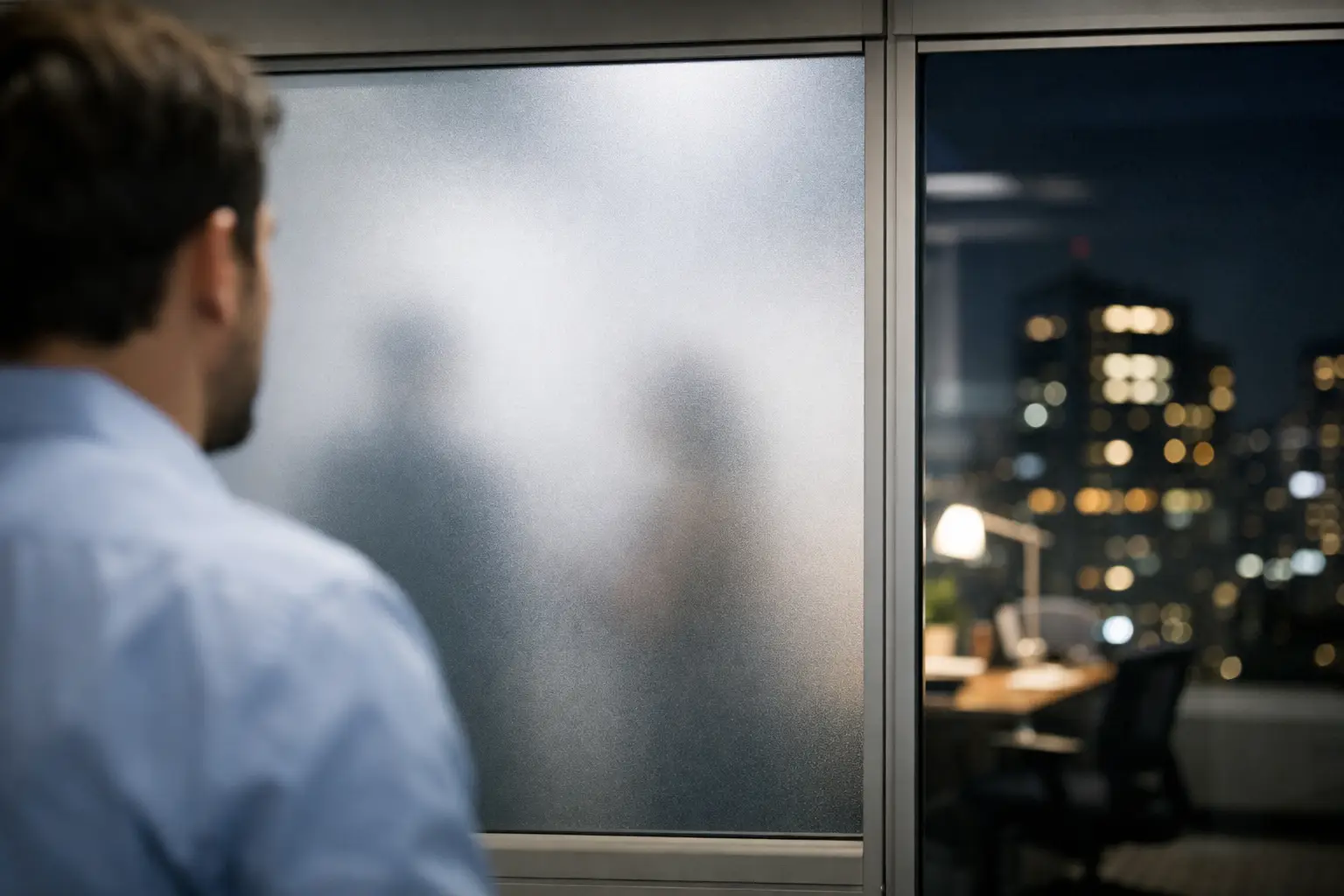
If you have ever stood inside a brightly lit room after sunset and wondered whether privacy film is still doing its job, the short answer is this: does privacy film work night? Sometimes, but not in the way most people expect.
That matters for San Diego homeowners, storefront operators, and office managers who want real privacy, not a product that only performs under perfect daytime conditions. Window film can absolutely improve privacy, but nighttime results depend on the type of film, the lighting on each side of the glass, and what level of concealment you actually need.
Does privacy film work at night for every window?
No. Standard reflective privacy film works best during the day, when the outside is brighter than the inside. In that condition, the film reflects more of the exterior light and makes it harder for people to see in.
At night, the situation usually flips. Your interior lights are on, and outside is darker. That means the glass can act more like a mirror from the inside looking out, while people outside may still be able to see into the room. This is the biggest misunderstanding property owners run into when they shop for privacy film.
If your goal is full nighttime privacy with interior lights on, a typical one-way daytime privacy film is usually not enough by itself.
Why privacy film behaves differently after dark
Window film does not create privacy in isolation. It works with available light. The brighter side of the glass generally sees more reflection, while the darker side can often see through.
During the day, sunlight outside gives reflective film an advantage. At night, indoor lighting often overpowers that effect. So if your living room, front office, or retail space is brightly lit, visibility from outside can increase.
This is why one customer might say a film works great, while another says it failed. They may both be right. A shaded home with limited interior lighting will get a different result than a storefront with bright LEDs aimed straight at the glass.
What privacy film can still do at night
Even when reflective film does not deliver true one-way privacy after dark, it can still help. The right film may soften visibility, reduce glare, obscure details, or make it harder to see clearly into a space.
That can be enough in some situations. For example, a commercial office may not need complete visual blackout. It may only need to reduce direct views of desks, equipment, or employees from a parking lot. In a home, you may simply want to blur the line of sight into a bathroom side window or lower-level room.
The key is matching the film to the actual privacy problem instead of assuming every film performs the same way.
Which types of film offer better nighttime privacy?
If nighttime privacy is your main concern, decorative and frosted films are often more dependable than reflective films. Frosted film does not rely on daylight to create privacy. Instead, it obscures the view through the glass at all hours while still letting light pass.
That makes it a strong option for entry doors, sidelights, bathroom windows, office partitions, conference rooms, and street-facing glass where privacy needs to stay consistent.
Darker tinted films can also help reduce visibility, but they are not the same as complete privacy films. They may make it harder to see in, especially from a distance, but under strong interior lighting they often still allow some visibility.
Dual-reflective films can improve the balance somewhat by using a more reflective exterior side and a less reflective interior side. These are often a better fit than basic mirrored film when customers want daytime privacy without making the interior feel too closed in. Still, they do not override the lighting issue entirely at night.
Does privacy film work night in homes?
In homes, the answer depends heavily on room use and window placement. A second-story bedroom may need only moderate screening because the sightline from outside is limited. A front-facing living room with large windows and bright lighting needs a very different solution.
For residential glass, homeowners often want three benefits at once: privacy, heat reduction, and protection from UV exposure. Some films can do all three, but nighttime privacy remains the point where expectations need to be realistic.
If you want to relax with the lights on and not worry about people seeing in from the street, frosted or decorative film on select windows may be the better answer. If you still want your outward view, then film alone may need to be combined with shades, drapes, or strategic lighting.
This is especially true for homes in denser neighborhoods where houses are closer together and viewing angles are more direct.
What business owners should know
For commercial properties, privacy needs are usually more specific. A medical office may need patient discretion. A street-level office may want to shield work areas. A retail business may want some visibility for displays but less visibility into inventory or back-office areas.
In those cases, the right film can solve a practical problem without making the property look closed off. Frosted bands, partial coverage, and decorative privacy film are often more useful than full mirrored film when nighttime consistency matters.
For storefronts and offices, there is also a trade-off between privacy and security perception. If glass is too dark, it can make a space feel vacant after hours. If it is too exposed, valuables and equipment are easier to see. A good installation plan accounts for both.
Common mistakes when choosing privacy film
The biggest mistake is buying based on the phrase one-way privacy without understanding that it is mostly a daytime effect. Another common issue is focusing only on appearance. A sleek reflective look may seem attractive, but it does not guarantee the kind of nighttime privacy many people assume it will.
Customers also underestimate the role of interior lighting. Bright overhead fixtures, uncovered lamps near windows, and direct light aimed toward the glass all reduce nighttime privacy. Sometimes improving privacy is not about changing the film alone. It is about adjusting the environment around it.
Finally, DIY film choices can create uneven results. Low-grade materials may haze, bubble, or perform inconsistently, especially on larger panes or sun-exposed glass. That is one reason many property owners prefer professional guidance before committing to a solution.
How to choose the right privacy setup
Start with one question: do you need daytime privacy, nighttime privacy, or both? From there, the right answer becomes much clearer.
If your priority is daytime privacy with heat and glare reduction, reflective or solar control films may be a strong fit. If your priority is round-the-clock visual screening, frosted or decorative privacy film is usually more reliable. If you want outward visibility during the day and stronger privacy at night, you may need a layered approach that combines film with blinds or shades.
Window size, orientation, nearby foot traffic, and indoor lighting all matter. So does the type of property. A house in Poway does not have the same privacy demands as a restaurant in Chula Vista or a professional office in La Mesa.
That is why an on-site assessment is often the smartest first step. An experienced installer can look at the glass, the lighting conditions, and the viewing angles, then recommend a film that matches how the space is actually used.
The practical answer most people need
Does privacy film work at night? Yes, some privacy films can help at night, but standard reflective film usually does not provide full one-way privacy after dark when interior lights are on.
That does not mean privacy film is ineffective. It means the right product has to be chosen for the right job. For many homes and businesses, window film still delivers major value through glare control, energy efficiency, UV protection, and added privacy. The part that needs careful planning is how much privacy you expect once the sun goes down.
A dependable window film solution should solve the real problem, not just look good on the glass. If nighttime privacy matters, be clear about that upfront so the recommendation fits your space, your lighting, and your daily use. That is how you end up with a result you are happy with long after installation day.